


Rhodiola Rosea
Rhodiola Rosea
- Join the 13,000+ who tried it — and swear by it
- Just one ingredient. No fillers, no blends. 400mg of pure Rhodiola Rosea
- Goes after the belly fat that won't budge — at the source, not the symptom
- Supports natural energy, a balanced metabolism, and sharper mental focus
- Encourages the kind of deep, uninterrupted sleep that actually restores you
Couldn't load pickup availability

How Does It Actually Work
How Does It Actually Work
Rhodiola Rosea works through four distinct biological mechanisms — all driven by a single plant, at the right dose.
HPA Axis Regulation
Rhodiola's rosavins and salidrosides act directly on the hypothalamus and pituitary gland. These are the brain structures that trigger cortisol release from the adrenal glands. They reduce the sensitivity of this system to perceived stress, meaning your body stops firing a full cortisol alarm in response to everyday pressures.
Within 2–3 weeks, the chronic cortisol elevation that has been driving your symptoms begins to normalize.
Neurotransmitter Restoration
Chronic cortisol suppresses the production and transport of serotonin and dopamine. These are the neurotransmitters responsible for mood stability, motivation, and calm.
Rhodiola inhibits the enzyme that breaks these compounds down and actively increases their transport across the blood-brain barrier. This is why users report a lifting of anxiety and improvement in mood.
You get a measurable neurochemical shift, not a placebo effect.
Mitochondrial Energy Production
Cortisol dysregulation impairs cellular energy metabolism by disrupting mitochondrial function.
Rhodiola's salidrosides activate AMPK — the enzyme that controls cellular energy balance — and improve the efficiency with which mitochondria convert nutrients into ATP.
This is the mechanism behind the sustained, crash-free energy improvement that distinguishes Rhodiola from any stimulant.
Cortisol-Driven Inflammation Reversal
As HPA axis signaling normalizes, cortisol-driven gut permeability begins to heal. The inflammatory cascade triggered by chronic cortisol — responsible for bloating, puffiness, and fluid retention — starts to resolve. Simultaneously, Rhodiola exerts direct anti-inflammatory activity by inhibiting NF-κB, a key inflammatory signaling molecule.
Most users notice physical changes — reduced bloating, lighter legs, less puffiness — in weeks 3–5.
The result: your stress response system, your neurotransmitter balance, your cellular energy production, and your inflammatory state all normalize — driven entirely by one ingredient, at the dose the science demands.
Shipping and Returns
Shipping and Returns

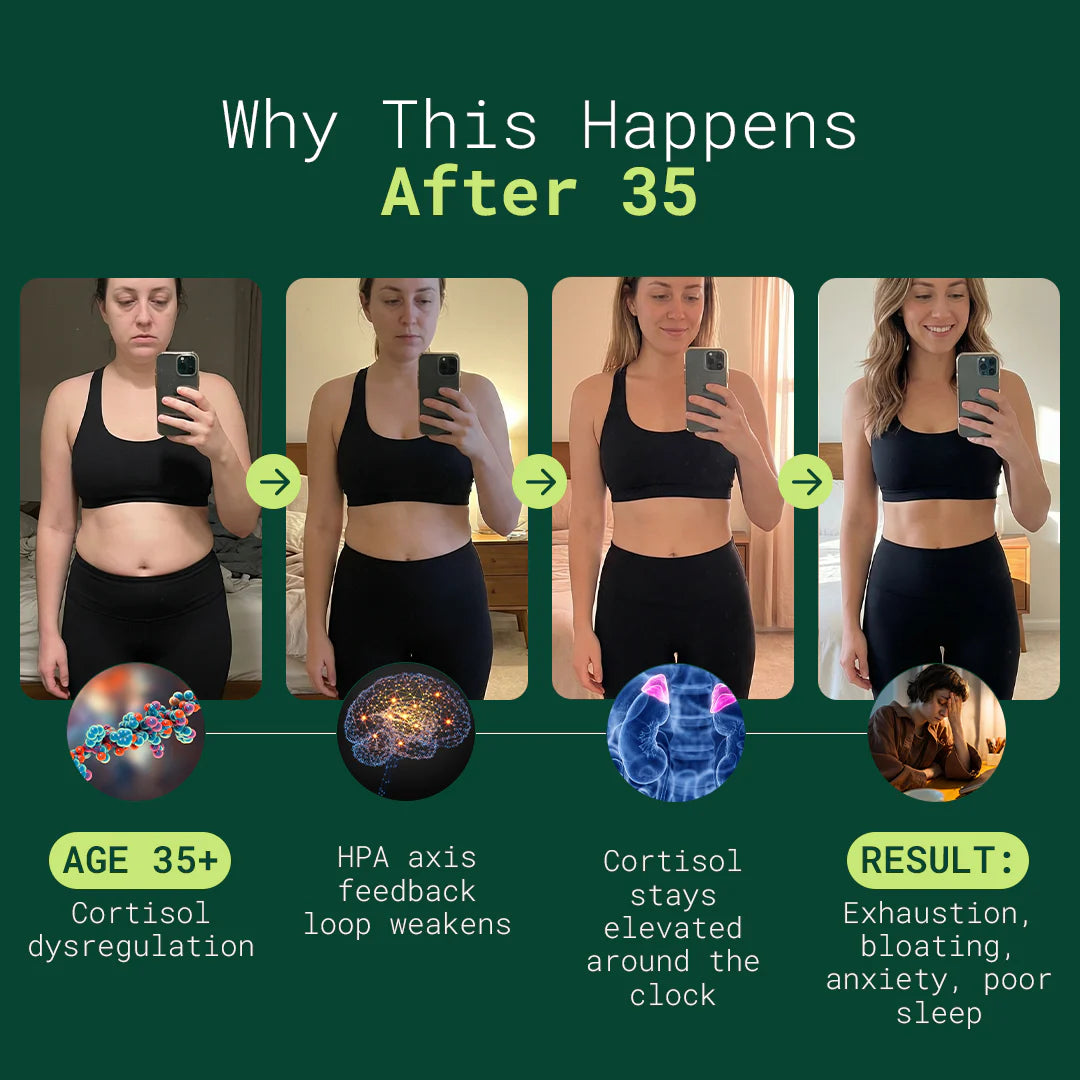

Why Your Bloating, Anxiety, Belly Fat & Exhaustion Are All Connected
If you're experiencing more than one of these symptoms, your body is trying to tell you something:
You wake up exhausted even after 8 hours of sleep — like you never rested at all.
Your belly is noticeably puffier and more bloated than it used to be, especially around the middle.
You feel anxious and on edge for no clear reason, even on quiet, uneventful days.
You crash hard in the afternoon and reach for coffee or sugar just to function.
You can't switch your brain off at night — lying awake, mind racing, unable to fall asleep.
These aren't separate problems.
They're all symptoms of the same root cause.
The Connection You've Been Missing
Your Hidden Stress Hormone System
Cortisol is your body's primary stress hormone — essential in short bursts, but catastrophic when it stays elevated. It's produced by the HPA axis (hypothalamic-pituitary-adrenal axis) — a communication network between your brain and adrenal glands.
When it's working properly, you don't even notice it.
- Cortisol rises briefly in the morning to wake you up.
- It drops by evening so you can sleep.
- Your body stays calm, energized, and balanced.
- Cortisol stays elevated around the clock.
- Adrenal glands become overworked.
- Feedback loops fail.
- Your brain stops regulating stress signals properly.
Why Nothing Has Worked
You leaned on caffeine and energy drinks to get through the day.
Caffeine doesn't restore your energy — it borrows it. Every cup pushes your cortisol higher, giving you a short lift followed by an even harder crash. Over months and years, this quietly deepens the HPA dysregulation you're trying to escape. You're not fixing the problem. You're accelerating it.
You downloaded meditation apps, tried breathwork, and read every stress-management article you could find.
Mindset practices are genuinely helpful — but they can't reverse a biochemical imbalance. Once your cortisol receptors have lost their sensitivity, no amount of box breathing can undo the hormonal cascade underneath. You were bringing meditation to a chemistry problem.
You picked up a 50mg or 100mg Rhodiola supplement from your local pharmacy or a big-box store.
This is the supplement industry's quietest scandal. Every clinical trial showing real results on Rhodiola uses 300–600mg of standardized extract. At 50–100mg, you're not in the therapeutic range — you're paying for a label with almost none of the active compound your body actually needs. Dose isn't a detail. It's the entire difference between something that works and something that doesn't.
A single, pure, maximum-potency dose of Rhodiola Rosea — standardized to the exact ratio used in clinical research, at 400mg per serving, with nothing added, nothing diluted, and nothing hidden in a proprietary blend.
Why the 400mg Rhodiola Dose Changes Everything
The dose most brands hope you'll never notice.
Most Rhodiola supplements on shelves today contain just 50–100mg — a fraction of what actual clinical research is built on. Others tuck their real dose behind a "proprietary blend" label so you have no way of knowing what you're actually swallowing.
What we do differently.
Soluma delivers 400mg of pure Rhodiola Rosea extract per serving, standardized to 3% rosavins and 1% salidroside — the exact concentration used in the peer-reviewed human trials that made Rhodiola famous in the first place.
At this potency, Rhodiola's active compounds (rosavins and salidrosides) are present in high enough concentrations to:
- Directly influence HPA axis signaling and help lower cortisol output
- Support serotonin and dopamine precursor transport across the blood-brain barrier
- Boost mitochondrial energy production at the cellular level
- Ease the body's physiological stress response within 2–4 weeks
- Help restore deep sleep architecture disrupted by chronic cortisol
- Reduce stress-driven gut inflammation behind bloating
- Sharpen mental clarity, focus, and resilience under pressure
One ingredient. No fillers. No blends. No distractions.
Just 400mg of the most clinically studied adaptogen on earth — at the dose that actually does something.